A bipartisan Obamacare fix remains out of reach in the Senate, for now, and lawmakers can’t agree on who is at fault.
While many agree that the forthcoming healthcare cliff will cause financial pain, the partisan divide quickly devolved into pointing the finger across the aisle at who owns the looming healthcare premium spikes that Americans who use the healthcare exchange will face.
Part of the finger-pointing has yielded another surprising agreement: Lawmakers don’t see the fast-approaching expiration of the Biden-era enhanced Obamacare subsidies as Congress failing to act in time.
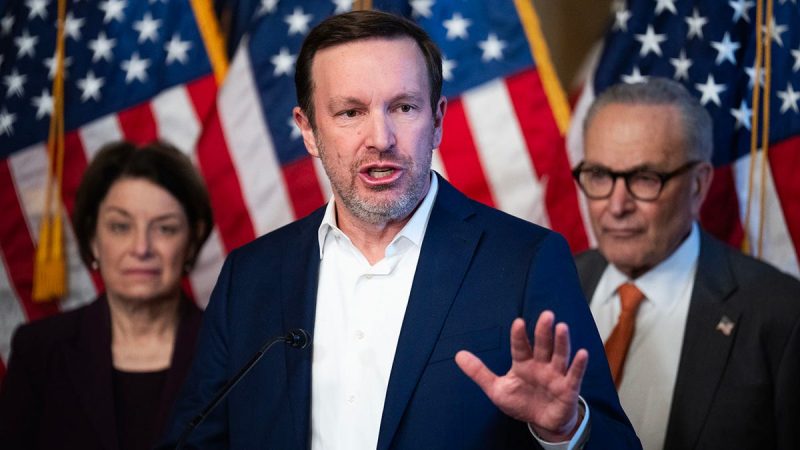
‘Obviously, it’s not a failure of Congress to act,’ Sen. Chris Murphy, D-Conn., told Fox News Digital. ‘It’s a failure of Republicans to act. Democrats are united and wanting to expand subsidies. Republicans want premium increases to go up.’
Senate Republicans and Democrats both tried, and failed, to advance their own partisan plans to replace or extend the subsidies earlier this month. And since then, no action has been taken to deal with the fast-approaching issue, guaranteeing that the subsidies will lapse at the end of the year.
A report published last month by Kaiser Family Foundation, a nonprofit healthcare think tank, found that Americans who use the credits will see an average increase of 114% in their premium costs.
The increase can vary depending on how high above the poverty level a person is. The original premium subsidies set a cap at 400% above the poverty level, while the enhanced subsidies, which were passed during the COVID-19 pandemic, torched the cap.
For example, a person 60 years or older making 401% of the poverty level, or about $62,000 per year, would on average see their premium prices double. That number can skyrocket depending on the state. Wyoming clocks in at the highest spike at 421%.
In Murphy’s home state of Connecticut, premiums under the same parameters would hike in price by 316%.
‘When these do lapse, people are going to die,’ Murphy said. ‘I mean, I was talking to a couple a few months ago who have two parents, both with chronic, potentially life-threatening illnesses, and they will only be able to afford insurance for one of them. So they’re talking about which parent is going to survive to raise their three kids. The stakes are life and death.’
Both sides hold opposing views on the solution. Senate Republicans argue that the credits effectively subsidize insurance companies, not patients, by funneling money directly to them, and that the program is rife with fraud.
Senate Democrats want to extend the subsidies as they are, and are willing to negotiate fixes down the line. But for the GOP, they want to see some immediate reforms, like income caps, anti-fraud measures and more stringent anti-abortion language tied to the subsidies.
Sen. Rick Scott, R-Fla., who produced his own healthcare plan that would convert subsidies into health savings accounts (HSAs), argued that congressional Democrats ‘set this up to expire.’
But he doesn’t share the view that the subsidies’ expected expiration is a life-or-death situation.
‘I’m not taxing somebody who makes 20 bucks an hour to pay for healthcare for somebody who makes half a million dollars a year, that’s what they did,’ he told Fox News Digital. ‘All they did was mask the increase in healthcare costs. That’s all they did with it.’
Sen. Jim Banks, R-Ind., similarly scoffed at the notion, and told Fox News Digital, ‘The Democrat plan to extend COVID-era Obamacare subsidies might help less than half a percent of the American population.’
‘The Republican plan brings down healthcare costs for 100% of Americans,’ he said. ‘More competition, expands health savings accounts. That needs to be the focus.’
Democrats are also not hiding their disdain for the partisan divide between their approaches to healthcare.
Sen. Brian Schatz, D-Hawaii, told Fox News Digital that the idea that this ‘is a congressional failure and not a Republican policy is preposterous.’
‘They’ve hated the Affordable Care Act since its inception and tried to repeal it at every possible opportunity,’ he said, referring to Obamacare. ‘The president hates ACA, speaker hates ACA, majority leader hates ACA, rank-and-file hate ACA. And so this is not some failure of bipartisanship.’
While the partisan rancor runs deep on the matter of Obamacare, there are Republicans and Democrats working together to build a new plan. Still, it wouldn’t deal with the rapidly approaching Dec. 31 deadline to extend the subsidies.
Senate Majority Leader John Thune, R-S.D., predicted that the Senate would have a long road to travel before a bipartisan plan came together in the new year, but he didn’t rule it out.
‘It’s the Christmas season. It would take a Christmas miracle to execute on actually getting something done there,’ he said. ‘But, you know, I think there’s a potential path, but it’ll be heavy lift.’